


Pulling something out of the archives here. When you have hundreds of old HTML pages, inevitably some get left behind on the old version of the site. With the news about the discovery of Shackleton’s ship, Endurance, I realized this needed to get updated and brought to the fore again.
I learned when reformatting this that Mr. Butler passed away last October. Which is a damn shame on many levels–for one, I think he would have been absolutely fascinated to see the actual Endurance. For another, I remember him as being a pleasure to talk to and I’m glad I had the chance to geek out on Shackleton with him for a short time. Here’s the interview as it appeared on this site…Jesus, twenty years ago.
George Butler is the director of The Endurance: Shackleton’s Legendary Antarctic Expedition, a documentary regarding the insane story of Sir Ernest Shackleton and how he and his expedition of twenty-eight men survived getting stranded on an ice floe and being lost for twenty-two months. The documentary is now getting some theatrical release across the United States. This conversation was held in person on 4/18/2002.
Widge: I saw the film–Cowboy [Booking International (the American distributor)] sent me an Academy screener, back when it first was making the festival rounds. I wanted to know the reason that it wasn’t nominated at the Oscars–because I was astounded that it wasn’t nominated. Was it ineligible?
George Butler: We got robbed.
W: Tell me about the crime.
GB: I wrote two lengthy, well-reasoned letters to the Academy, and they really felt badly about it, because the head of the Academy, no less, wrote me back a two-page letter saying essentially, “No.” And a two-page “No” letter is a very long “No” letter. But they have a battery of rules that face documentaries, and it makes it virtually impossible for a popular, big-spirited documentary that goes out into the marketplace to get an Academy Award nomination. When I went to the Antarctic, I went to the most remote location to shoot on earth–if you can find another movie shot in a more remote location, please let me know.
W: Probably not on this planet.
GB: Exactly. And it was expensive. And in order to do that, I shot four films, including an IMAX, two TV versions, and The Endurance. One of the TV versions played in England and Germany, and got two British Academy Award nominations. It’s a very different film from The Endurance. They said it’s based on the same material, and I said, in that event, if you’re saying you cannot be on television and get an Academy Award, then all the films that use any stock footage for the last twenty year would be ruled ineligible because they’ve all played on TV. But they said, “But the director didn’t put them on TV.” And then you get into a morass and now stiff counterarguments and arguments, and the essential fact is Frederick Weisman has never been nominated for an Academy Award, Errol Morris has never been nominated for an Academy Award. Any film that’s popular and has wide distribution is going to run afoul of one of their rules or the other, and the Academy Awards, as you know, are basically popularity contests in the feature division. In the documentary division, there’s an obscurity contest, and none of the films that are nominated are getting theatrical distribution. So it doesn’t make any sense at all.
W: You didn’t suffer for your art enough, I guess.
GB: Exactly. And I’m very grateful for what’s happened [with] The Endurance. It is quite simply the most successful documentary of the last five years–probably the most successful commercial documentary since Hoop Dreams, and I’m delighted, and Cowboy has done a great job.

W: Well, backing up to the beginning…how did you get started in making documentaries? I mean, when you were a kid and everyone wanted to be a fireman or an astronaut, you wanted to make movies about them being firemen and astronauts, or how did that start?
GB: I never took a film course, I never thought I’d be in film, I never went to film school, I never had any connection to the movies. In fact, I grew up in Africa and Jamaica and the West Indies. I almost didn’t see movies as a child. And the ones I did, I remembered very clearly. And I did not have a deprived childhood of any kind. I had a wonderful sort of foreign childhood in Africa and places like that. What happened was is that I went to the University of North Carolina as a writer–I went to graduate school as a writer in Virginia at Hollins College. I worked for Newsweek, I published a newspaper in Detroit…and then I became a still photographer. And I did a book on the Vietnam war with Senator [John] Kerry from Massachusetts, and then I was asked, oddly enough, to do an assignment for Sports Illustrated on a obscure bodybuilding contest, which I did, and I was fascinated by what I saw. And we started doing a book called Pumping Iron, and I was working with a writer named Charles Dance from Birmingham, Alabama, and we ran into Arnold Schwarzenegger. And the original contract was with Doubleday, and when the book was finished, we handed in the photographs of Arnold and the other bodybuilders and the text to the editor-in-chief of Doubleday, a man named Sandy Richardson. And he wrote us back a letter saying, “this book is an insult to the company–no one will ever want to look at a photograph of Arnold Schwarzenegger or read about him. Please give me my advance back” — which is very rare for a publishing company — “you have wasted our time and misspent our our money.” The book ended up at Simon & Schuster–
W: That was a long “No” as well, actually.
GB: Yes. Actually, you’re right. The book ended up at Simon & Schuster, was an immediate best seller. And I thought, “Now, someone should make a movie about Arnold Schwarzenegger”–and wrong again–because no one would touch him. I did a test film of Arnold and…I had a hundred people come in to invest in the film and they laughed at him all the way through. And Romulus Linney–who’s from Tennessee, who’s Laura Linney’s father, the actress, and he’s a playwright in his own right–got up and said, “George, I’m gonna speak for all your friends in this room. If you ever make a movie about Arnold Schwarzenegger, you will be laughed off 42nd Street.” It was like this all the way through. People hated Arnold Schwarzenegger in those days, they hated body building, they didn’t want anything to do with it, because it was new. It was entirely new. And…the rest is history, because Arnold went on to become the biggest star in the movies in the 90s. Pumping Iron is getting a gigantic re-release in October from HBO. I’ve been on the phone all morning with Variety about this re-release. Sports Illustrated just called it one of the classic movies on sports, put it on their five best list of best sports movies ever. And…it’s an authentic American classic, but it was not easy to make, because it was highly original. And we went through a lot of the same stuff with Shackleton.

W: So…you went from Pumping Iron and the sequel…
GB: Pumping Iron 2.
W: And then In the Blood…and then nothing filmwise until Endurance. I was looking in the Internet Movie Database…
GB: I’m a photographer, I publish…I’ve taken a hundred thousand photos, I’ve published five books. I was just on the phone with John Kerry’s office, I’ve worked in politics. I’m fairly widespread. But I did make four movies simultaneously in the Antarctic on Shackleton. And in the sort-of mid-90’s, I had two scripts that were optioned by Miramax and MGM. And you know what it’s like in Hollywood, you get near misses. I truly had some big near misses.
W: So with Endurance and with Pumping Iron coming back…people love success stories, or re-success stories, or what have you, are people looking at the scripts again, or…?
GB: Shackleton…hasn’t hurt my reputation.
W: I would think not.
GB: The interesting thing is, is that I did four very different films in the Antarctic under extraordinary circumstances, and it’s started a worldwide phenomenon, not unlike Pumping Iron, so I can only benefit from it.
W: Now this story has been around–
GB: For eighty years.
W: For eighty years…and I myself had only heard the outline of the story and didn’t really know the details of it until I had seen Endurance. I know that there’s been books, there’s been a feature that’s been in the works for a while–I think that Mel Gibson was mentioned to play Shackleton at one point. Why did this take so long for this to come to the fore?
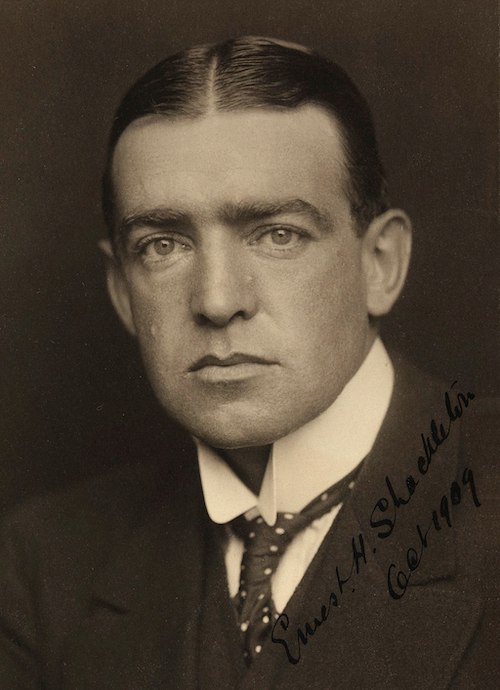
GB: Essentially, what happened was is that…even though I have an Irish background and went to some British schools, I didn’t know who Shackleton was. And I picked up a book on Shackleton–the Lansing book on Shackleton–in 1996 in a bookstore by mistake. I thought it was another book. It was right next to the cash register, and I just put it in a pile of books I was buying, ’cause I thought it was something else. And I started reading it out of curiosity, and [Endurance writer/producer] Caroline Alexander walked into the room, and I said “This is an extraordinary story.” She said, “Let me see.” And she took the book and read it in one sitting. She owed Knopf, her publisher, a book under contract and she decided to do a book on Shackleton’s ship’s cat, Mrs. Chippy, who’s in the film. And in doing the research for that book, she went to London, went into the Royal Geographic Society, and asked to see their collection of Frank Hurley photos. They responded, “Who is Frank Hurley?” She said, “The famous Shackleton photographer.” And they said, “Look in the card catalog.” His name wasn’t listed in the card catalog. She had to go in the back of the museum and she found the photos–the original glass plates–stored in the most slipshod kind of way.
W: Wow.
GB: She said, when she looked at the photos, “These are masterpieces.” She came back, and went to the Museum of Natural History in New York and suggested an exhibit. They said, “Who’s Shackleton? Who’s Hurley? Why should we do this? One word answer: no.” Caroline and I ran into a philanthropist in New York who said, “I will pay for the exhibit.” Museum immediately said: “Of course we’ll do this exhibit.” And while she was preparing the exhibit, she was writing a catalog for the exhibit, her editor at Knopf heard about this, read the catalog and said, “Let’s do this as a book.” So she did simultaneously, the show–which was a major success in New York, got fabulous attention–and the book, Knopf decided to publish The Endurance: Shackleton’s Legendary Antarctic Expedition. So Caroline really started the trend for the first time in eighty years, and my films have popularized the trend. And between us, I genuinely think we’re responsible for the renewal of interest in Shackleton. The A&E film was based on her book, so that came later. All of the books were out of publication with the exception of Lansing’s Endurance at the time–they’ve all been brought back into print. And now, there are thirty-one books in print on Shackleton, George Plimpton’s doing a new biography of Shackleton. And I’ve got four films out, and there’s the A&E film, there’s the Biography film, etc. etc. So we’ve started an industry, very much the way we did Pumping Iron, or at least, I did.
W: So all of this can essentially be traced back to a mistaken impulse buy at a bookstore.
GB: Yeah. In fact, it’s one worse than that, or one step further away. I had read Apsley Cherry-Garrard’s book, The Worst Journey in the World, which is a famous adventure story, set in the Antarctic, from [Robert] Scott’s earlier expedition. And I thought it was…it opened up the idea that the Antarctic was interesting, which had never occurred to me before. I mentioned this to a friend of mine who’s a filmmaker, film director, producer named Julian Krainin, and he had said, “You know, George, there’s one better book on the Antarctic than that,” and he mentioned the name of it but I forgot ’cause three years went by. Then I was in the bookstore, and I saw a picture of a ship caught in the ice and it said “Antarctic” on the cover. So I just bought it.
W: Figuring how many stories about the Antarctic could there be?
GB: Exactly. So after I read the book, I went to Julian Krainin again and I said, “Julian, thank you. You gave me a great idea for this film project.” And Julian said, “What?” And I said, “Yeah, the book on Shackleton.” And he said, “…….Who’s Shackleton?” So it was a double mistake.
W: So I have to ask: Did you ever find the book that you were originally looking for?
GB: He couldn’t remember what he’d mentioned.
W: So you’ve never seen it.
GB: So I don’t know what he was talking about. But I do know that it came from his offhand comment–it was a long conversation, late at night, a long time ago, and I just heard “Good book on the Antarctic.”

W: I know you mentioned the A&E movie.
GB: Yeah.
W: Have you seen it?
GB: Yeah.
W: What did you think?
GB: I think it was a great effort, I think it’s a good film. I think they made one major mistake, if not two. They shot in Greenland, instead of the Antarctic, and I think you can tell. And…what I have also discovered, because I’ve been to thirty film festivals with The Endurance and I’ve spoken in twenty other cities, like Atlanta, opening the film. Wherever I talk with the film, the audience’s questions always address only the expedition. People are not interested in Shackleton raising money, or speaking to his wife or not speaking to his wife. The audience for this story is…it begins in Grytviken in 1914, it goes through the ice and then it comes back to Grytviken. That’s it. And I think that Channel Four, who produced the A&E special, miscalculated with all the backstory in Shackleton. You don’t need ninety minutes of Shackleton raising money to get into the story. I also believe that the A&E film kind of treats it like a Hollywood story and you never really believe those guys are suffering in the film. And…I’m actually talking to a production company in England, a major company, about directing the big Shackleton film with Liam Neeson playing Shackleton. I would make the movie like Das Boot. You know, very very sort of tough, highly confined, I would limit it to pain and suffering. And I would really show how difficult the voyage was, so at the end of the story, you would say, “Yes. A miracle took place. Because there’s no way the men could have gone through the story.” And that’s exactly what The Endurance does. We focus, as you’ll notice, on the Endurance expedition.
W: While I was watching Endurance, I didn’t know all the details at the time–the trek across the island, 870 miles over open ocean–I knew it was a true story, but part of me was thinking, “Somebody made this up.” Because this is a preposterous story…and yet it’s true. When you were making these four films, did you ever just sit there and think, “This is crazy. How could this possibly have happened?”
GB: I’m going to be at a screening of the film tonight. And I’m going to get up and tell the audience that I’ve been to all of the Shackleton locations, and it is physically impossible for twenty-eight men to survive for 635 days essentially living on icebergs in the Antarctic. Can’t be done. Can’t live for a week down there. And if anyone from the CBS [show Survivor] were sent to Elephant Island, they’d die the first night. And it’s literally true. The sort of talisman for the question…or the talisman that explains the question you’re asking…I always refer to the fact that when the Museum of Natural History opened the exhibition in New York, they took out a full page ad in Time magazine, and the essential copy said: “It is rare that a scientific institution will acknowledge the possibility of a miracle, but in the case of the Shackleton story, the miracle actually took place.” That’s why the fourth man part of this story is interesting. Despite the fact that I did not step forward to do this–we just won an award as one of the best religious movies of the year. Because it’s a story about a miracle. And I didn’t set out to make a religious film, but it does have a very spiritual side to it, or a spiritual explanation, because there’s no other way you can…I’ve been to all those locations. You can’t live on Elephant Island for six months. You can’t live on ice for six months. You can’t make that famous voyage from Elephant Island to South Georgia and survive–it. Can’t. Be. Done. But that’s why this story is so fascinating, and it really grips people these days…it really ah…it really…defies–there’s something in contemporary people’s minds which is a yearning for a story like this, which I can’t quite explain. It got a tremendous ride off the interest in survival stories, and then it got a second wave of interest because of 9/11–because the Shackleton story is the perfect way of taking a disaster and turning it into an unmitigated success. Which is what happened in New York, and what’s going on in New York right now. And then there’s been a kind of third wave of interest, which is: for one reason or another, businesses all over America are fascinated by the Shackleton story. And that’s why Morgan Stanley’s interest in this story has been so helpful to me as a filmmaker, because no major U.S. corporation has ever sponsored a movie by an independent filmmaker like The Endurance. Morgan Stanley’s money allowed me to go to the Antarctic, and then Tyco and Monster.com–they’re both Fortune 400 companies–came in with post-production money to allow me to get great music and stuff like that. And so, the business community’s interest in the film has been a tremendous help to me.
W: You had mentioned the other three versions of the film. One is the IMAX version, which is narrated by Kevin Spacey, is that right?
GB: Yeah.
W: What are the other two versions? I know you said there was one that aired in Britain…
GB: That’s a two-hour European TV special, which is quite different from The Endurance.
W: Are there any plans to release it domestically, on video or anything like that?
GB: Now I also directed a two-hour PBS special which is the Nova film, which appeared on April 26th.
W: One last question, to wrap up: now that you’ve got all of the Endurance stuff, and you’ve got the four films, and you’re looking at making the fifth film…do you have any plans for what comes after?
GB: Yeah, absolutely. I’d love…it’s the twenty-fifth anniversary of the release of Pumping Iron, as we said earlier. I’d love to do another sports film, and I’m looking into two. I’ve spent a lot of time with Bobby Bowden, the coach of the FSU Seminoles. He’s about to become the most winning coach in college history. I see him as a sort of Will Rogers kind of character. And he…he’s extraordinarily charming, they play great college football, and it’s very colorful American stuff. No one’s made a college football film the way I think I could. Nike wants to back it and I’m working on it actively right now. I also had a meeting yesterday which has opened up a possibility of doing a film on Mike Krzyzewski and Duke. So I’ll do one of those two or maybe both. The other bigger project I’ve got is that NASA has been talking to me about the possibility of doing an IMAX on the next mission to Mars. And…it’s a fascinating prospect because they’re gonna have IMAX quality cameras on Mars. So I’ve been spending a lot of time at Cape Kennedy and at the Jet Propulsion Laboratory looking at that. And there’s the English production of Endurance…I’ve also–if you’re a director and you’re independent, you’ve always got to have six balls in the air. I’ve got another movie that’s set in Jamaica which is a love story, a dark love story, which I’d love to do. And, you know, there are a couple of other projects which might or might not go. But any film that I’d do would have an exotic nature to it. I don’t know how you make Duke and Krzyzewski exotic, but I’d figure out a way to do it. Bobby Bowden is exotic just by definition. I have seen things in Tallahassee that are just wonderful.
The documentary can be seen here.


